
Database design best practices
Key takeaway
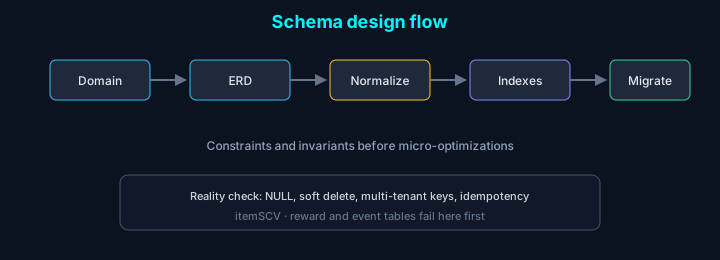
In one line: Schema starts from domain invariants. Normalization, indexes, and partitioning come next; skip multi-tenant boundaries or idempotency keys in reward/event systems and migrations get expensive.
| Phase | Output |
|---|---|
| Domain model | glossary, draft ERD |
| Constraints | FK, UNIQUE, CHECK |
Introduction
Changing schema late is painful—migrations and downtime add up. After fixing normalization, indexes, and relationships on reward, event, and user data, we wrote down what we wish we had done earlier.
Normalization
Normalization removes redundancy and protects integrity.
First normal form (1NF)
Each column holds atomic values only.
Second normal form (2NF)
Remove partial functional dependencies.
Third normal form (3NF)
Remove transitive dependencies.
Indexing strategy
Indexes speed reads but can slow writes if overused.
Basic indexing
Choosing indexes
- Columns in WHERE
- JOIN keys
- ORDER BY / GROUP BY
- High-cardinality columns (many distinct values)
Composite column order
Put the most selective column first.
Relationships
One-to-many
Many-to-many
Use a junction table.
One-to-one
Choosing data types
Types affect storage and performance.
Numeric types
String types
Date and time
Constraints
Constraints enforce integrity.
Primary key
Foreign key
Check constraints
Unique constraints
Performance
Partitioning
Split very large tables.
Query patterns
Security
SQL injection
Permissions
Monitoring and maintenance
Slow query logging
Statistics
Conclusion
- Normalize to cut duplication and protect integrity
- Index wisely for read paths you actually use
- Pick types that match cardinality and precision needs
- Use constraints so the database enforces rules
- Monitor and tune continuously
These practices help you build databases that scale and stay maintainable.