
IT & digital trends to watch in 2025
Key takeaway
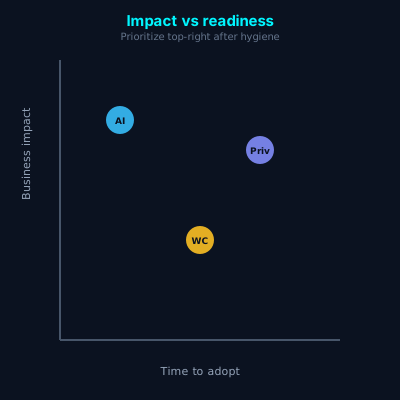
In one line: Prioritize trends by business impact and readiness to adopt. Teams that invest in governance, privacy, and web platform basics first can experiment faster without blowing up production.
Why bother reading trends?
In 2025, IT and digital move faster than ever. AI, Web3, SaaS, XR, and data-driven marketing are all competing for attention. The teams that win are not the ones that chase every buzzword—they map trends to what they can ship and what they can operate. Below is how we frame trends when advising clients and our own products.
1. Generative AI goes mainstream—now make it operational
Examples
- Global fashion retailer Zara used the ChatGPT API for a support chatbot; press coverage claimed on the order of tens of thousands of tickets per month with a large share automated and faster handling times.
- Korean media startup NewNeek used Midjourney for newsletter thumbnails, freeing designer time for higher-value work.
- HubSpot shipped AI-assisted email copy to shorten campaign setup cycles.
Checklist
- Which repetitive workflows (FAQ, catalog copy, internal Q&A) are realistic first targets?
- Can you connect your data (FAQ, product DB) safely?
- Is there a human review path before customer-facing output ships?
- Do you have ethics, copyright, and privacy guidelines?
- Can you measure time saved, cost, and quality (not just “we use AI”)?
Failure modes
- Chatbots trained on thin or dirty FAQs increase complaints.
- Shipping generated content without review invites factual errors and IP issues.
Practical moves
- Start where volume is high and harm from a wrong answer is bounded.
- Automate drafts, not final legal or financial statements, unless you have strong verification.
- Track KPIs before/after: handle time, cost per ticket, CSAT.
2. Web3 and blockchain—real utility, not stickers
Examples
- Starbucks experimented with an NFT-style loyalty journey (Odyssey) in the US.
- Kakao’s Klaytn ecosystem powers payments, transfers, and points-style programs for some services.
- Game studios have run high-volume on-chain item trades where regulation and UX allow.
Checklist
- Does on-chain add concrete user value (transferable assets, composability) vs a database row?
- Is wallet onboarding tolerable for your audience?
- Legal review (AML, tax, consumer protection) done early?
- Do tokens/NFTs unlock real perks (discounts, access)?
Failure modes
- “NFT for hype” with no benefit → churn.
- Complex wallet flows block mainstream users.
- Launching without regulatory clarity → shutdown risk.
Practical moves
- Run a small pilot with measurable retention or ARPU impact.
- Invest in social login, custodial options, or abstracted wallets where it fits.
- Pair with legal counsel before marketing claims.
3. SaaS and cloud evolution
Examples
- Notion’s all-in-one workspace scaled to very large global usage.
- Enterprises mix AWS, Azure, and GCP by workload to optimize cost and resilience.
- Zapier-class automation platforms route billions of events across SaaS APIs.
Checklist
- API coverage, export, and migration path before you commit.
- Do you need multi-cloud or hybrid for data residency / DR?
- Security baseline: SSO, SCIM, encryption, audit logs.
- FinOps: budgets, anomaly alerts, rightsizing.
Failure modes
- Integration surprises after contract signature.
- Multi-cloud without platform discipline → cost and incident complexity.
- Misconfigured SaaS permissions → data exposure.
Practical moves
- Use IaC (Terraform, Pulumi) and policy-as-code where possible.
- Quarterly access reviews for critical SaaS.
- Tag spend by product line so owners feel the bill.
4. XR and metaverse as tools, not demos
Examples
- Samsung has used XR-style spaces for onboarding and training pilots.
- Nike experimented with Roblox storefront experiences with large visit numbers reported in press.
- Universities ran metaverse campuses to improve remote participation metrics.
Checklist
- Clear goal: training, marketing, collaboration?
- Device mix: desktop, mobile, headset—what must work day one?
- Start with a pilot cohort and explicit KPIs.
Failure modes
- Cool demo, no business metric.
- Hardware fragmentation kills retention.
- Big upfront capex without ROI model.
Practical moves
- Define KPIs: completion rate, NPS, conversion, cost per engaged user.
- Prefer experiences that work on phones and browsers first.
- Iterate weekly with a small user panel.
5. Digital marketing under privacy pressure
Examples
- Musinsa leaned on first-party commerce data for recommendations and retargeting efficiency.
- Sephora-style personalization stacks lifted revenue in public case studies.
- Patagonia and peers invested in first-party data as third-party cookies faded.
Checklist
- First-party data strategy (signup, events, surveys) with quality checks.
- Consent and notice flows that pass legal review.
- Omni-channel analytics (web + app + offline) where relevant.
- ML targeting only where you can explain and audit outcomes.
Failure modes
- Weak consent UX → regulatory and trust issues.
- No cookieless plan → CPM and attribution collapse.
- Dirty data → wasted ad spend.
Practical moves
- Instrument server-side and first-party events (e.g. GA4, CDP).
- Document data retention and purpose limitation.
- Build feedback loops between growth and data teams weekly.
Conclusion
Trends only matter when they become scoped pilots with metrics. Pick one theme per quarter, run a controlled experiment, read the numbers, then scale or kill. Execution beats slide decks.