
AWS, Naver Cloud, and GCP side by side through a DevOps lens (2025)
Key takeaway
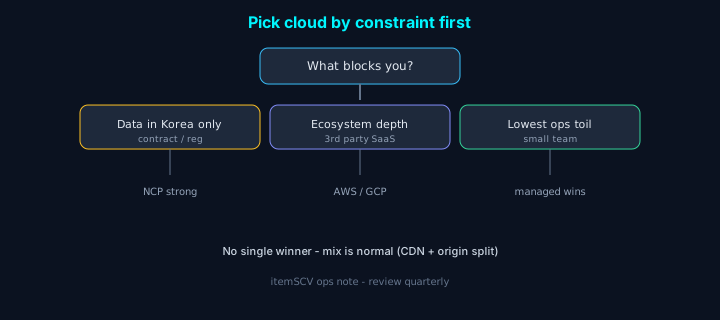
In one line: Cloud comparison is not a spec sheet—it starts from constraints (data residency, team skill, contracts). All three are usable; why you pick first usually differs.
| Situation | Common pick | One-line reason |
|---|---|---|
| Domestic data / contract pins a region | More NCP | Easier accounting, docs, and tax-invoice flows in practice |
| Global SaaS, references, hiring pool | AWS or GCP | Tutorials, third parties, and partners are overwhelmingly there |
| “Just run Kubernetes well” | Whatever the team knows | Operating routines eat cost more than the logo |
Opening: why “which is best?” has no answer
That’s often the first question in the room—“AWS, right?” or “Domestically, isn’t it Naver?”
I used to argue for one side; now I reframe: “What constraints must our team survive next quarter?”
At itemSCV we run web, APIs, batch, and occasional GPU workloads—often not a single vendor. CDN here, stateful DB there, experiments elsewhere. What matters is drawing boundaries so mixed names don’t break operations.
This article lines up AWS, Naver Cloud Platform (NCP), and Google Cloud (GCP). Azure competes too, but by discussion frequency and references in our team we skip it here (a separate post could cover it).
1. Start with the same picture: service name mapping
Cloud migration meetings derail most often because vocabulary differs. VPC, VMs, object storage, Kubernetes—the pattern is the same; only branding changes.
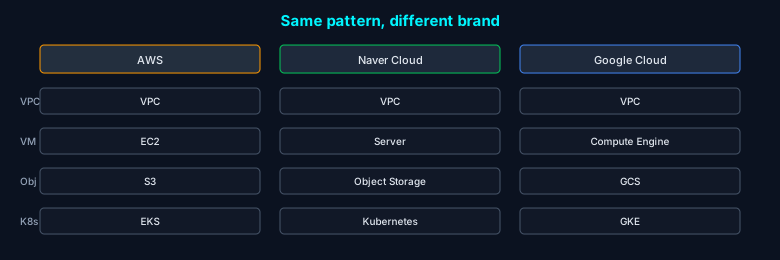
The diagram is for concept alignment. SKUs, generations, and prices change—re-check the console and official docs for quotes. Aligning Terraform module names and runbook titles this way still makes on-call calmer.
2. Latency for Korean users: “Seoul region exists” is not the end
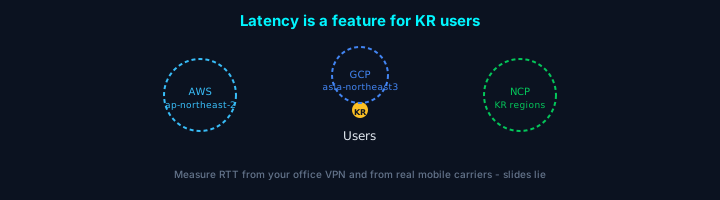
All three have Korea or nearby regions. In production, single-digit ms RTT can still matter—especially over mobile, public Wi‑Fi, or corporate VPN paths that never appear on slides.
Practical tips:
- Don’t stop at ping on the production traffic path—re-measure real API handshakes.
- Put CDN in front of static assets; keep origin focused on compute and DB.
- I’ve seen teams move overseas for cost and then bleed people cost when support time zones misalign.
3. What people really mean when they choose Naver Cloud
Choosing NCP isn’t always “patriotism.” Recurring themes:
- Contracts, tax invoices, domestic billing are easier for finance/procurement to explain
- Korean support and training speeds onboarding (varies with team English level)
- Some RFPs explicitly require domestic IDC wording
Conversely, if a global third party only “officially supports AWS,” NCP-only is hard. Then you see split designs: front/data on NCP, specific integrations on AWS.
4. Traits of orgs that default to AWS
Teams that treat AWS as default often:
- Already have IAM, VPC, and org account structure—migration is expensive
- Want reference architectures straight from marketplace/partners
- Plan multi-region expansion with one pattern
Caveat: So many services that small teams get lost. “We turned it on” resources pile up until cost alerts fire. We’ve often retro’d that tag policy should have been enforced earlier.
5. Where GCP shows up (especially data / ML)
GCP often enters via BigQuery, how GKE is operated, or a specific data pipeline. “You can do similar elsewhere” is true—but familiar query and permission models cut migration cost.
Korean material density and domestic partner pools can feel different from AWS/NCP, so you sometimes see split by team: “data on GCP, apps elsewhere.” Without documenting peering and cost allocation, that becomes political later (speaking from experience).
6. Don’t end cost comparison at a table
We avoid blogging “A is N% cheaper than B” because commitments, savings plans, spot, and credits make every reader’s answer different. A question list you can use internally is still worth sharing.
| Question | Why it matters |
|---|---|
| Is traffic steady or spiky? | Reserved vs on-demand mix |
| What share of revenue does egress eat? | Origin, CDN, cross-region quietly grow |
| Can you use a support plan in incidents? | Can second-shift on-call handle English calls? |
7. Multi-cloud: a boundary problem, not bragging rights
Framing multi-cloud only as “high availability” is thin. What you usually need:
- Identity boundaries — accounts don’t linger when people leave
- Network boundaries — peering vs public endpoints
- Observability — one pane of glass vs hopping consoles
With Terraform or Pulumi, three vendors in one repo without module ownership rules becomes PR hell. Even “only Alice merges NCP” helps.
7-1. Three real-world profiles—”where are we close?”
Compressed from recurring meeting profiles, not fiction. Numbers are illustrative—don’t copy-paste as budgets.
A. Series A startup (4 engineers, Korea only)
| Topic | Reality | Common choice |
|---|---|---|
| Traffic | Under ~100k req/day, spikes | Managed K8s or single-region VMs + autoscale |
| Data | Contract: Korean PII storage | NCP or AWS Seoul with explicit region lock |
| Integrations | Payment/email SaaS | Vendors with more AWS/GCP samples in docs win |
Compromises like VPC peering or API-only cross appear more often than “NCP only” vs “AWS only.”
B. Public / quasi-public procurement
| Topic | Reality | Common choice |
|---|---|---|
| Contract | Domestic IDC, domestic billing | NCP share often large |
| Audit | Access logs, key-management evidence | CloudTrail-class + KMS documentation |
| Staff | Handoff with SI vendors | Korean runbooks help maintenance |
C. Global SaaS (US, EU, KR customers)
| Topic | Reality | Common choice |
|---|---|---|
| Regions | EU residency + low latency in KR | Multi-region required; teams often know AWS or GCP |
| Billing | Stripe + multi-country tax | Single org bill via AWS Organizations / GCP Billing |
7-2. Terraform provider “skeleton” only (not copy-paste prod)
When PoC-ing provider swaps in one repo, block shapes eat time. Below is shape-only.
NCP has a Terraform provider too—pin allowed versions and modules in policy first. We broke prod once pasting “latest blog” examples and hitting a provider major upgrade; version pins are mandatory for us.
7-3. kubectl context switching—muscle memory for multi-cloud
Rotating among EKS, NCP Kubernetes, and GKE, which cluster am I in? causes incidents.
Rule of thumb: show ctx in your prompt or use kubectx with color. The joke about kubectl delete pod hitting the wrong company’s cluster happens for real.
7-4. One-week PoC checklist (same scenario on all three)
| Day | Task | Example pass criteria |
|---|---|---|
| 1 | VPC + subnets + NAT (if needed) | VM reaches internet and internal DB |
| 2 | Object storage upload + minimal IAM role | Read without app keys, role only |
| 3 | Observability: metrics + logs in one view | Fire one test alert |
| 4 | Click backup/snapshot restore | RTO matches the doc |
| 5 | Set cost alert thresholds | Confirm email on intentional overrun |
Going deep on one vendor turns the PoC into a decided demo. Filling the same row three times is the point.
7-5. Incidents—time zone is operations cost
Real life: US-region outage, support window in PST → Korean on-call takes 3 a.m. English calls. Domestic vendors/partners can overlap business hours more comfortably.
| Question | Why it matters |
|---|---|
| Business support response SLA | Breathing room on P1 |
| Can on-call do English? | If not, weight domestic vendor/partner |
8. One-pager we fill when a new project starts
Half joking—if we fill these five lines, meetings often halve:
- Countries where data may live (agree up front)
- Mandatory SaaS integrations (any vendor lock-in?)
- On-call language (when English calls are OK)
- Budget cap and alert channel (which Slack?)
- Can we migrate in 3 months? (if not, accept lock-in consciously)
Closing
There is no permanent #1 among AWS, Naver Cloud, and GCP—that’s marketing. In the field, constraints and team state win. This article is a starting point: “under these conditions, we often see X.”
Product specs change quarterly; before big decisions, a small PoC is still the cheapest proof. Walk the same scenario—VPC, backup, monitoring—on a tiny workload, score it including who actually operates it.