
Microservices architecture: design and monitoring
Key takeaway
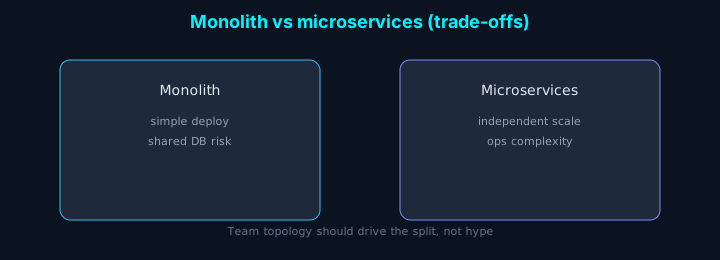
In one line: Microservices pay off when they align with team boundaries and independent deploys. Compared to a monolith, operations, observability, and distributed transactions cost more—document why you split before you split.
Introduction
Microservices can reduce “one bad service takes down everything” risk from monoliths—but poor design, deploy, and monitoring only add complexity. Drawing on how we split domains like rewards, events, and analytics, here are the core ideas and operational patterns.
Core principles
1. Single responsibility
Each microservice should focus on one business capability.
2. Independent deployment
Each service should be deployable on its own.
3. Database per service
Each service should own its data store.
Inter-service communication
Synchronous: REST
Asynchronous: message queue
Event-driven architecture
Service discovery
Eureka
Kubernetes service discovery
API gateway pattern
Distributed tracing
OpenTelemetry with Jaeger
Monitoring
Metrics (Prometheus)
Structured logging (Winston)
Failure handling
Circuit breaker
Retries
Deployment strategies
Blue-green
Canary (Istio)
Conclusion
To succeed with microservices:
- Clear service boundaries: explicit ownership per service
- Right communication model: sync vs async by use case
- Strong observability: tracing and metrics for system-wide visibility
- Resilience: circuit breakers, retries, and graceful degradation
- Progressive rollout: blue-green and canary to limit risk
These principles help you build systems that scale and remain operable.