
Web application security best practices: a practical guide
Key takeaway
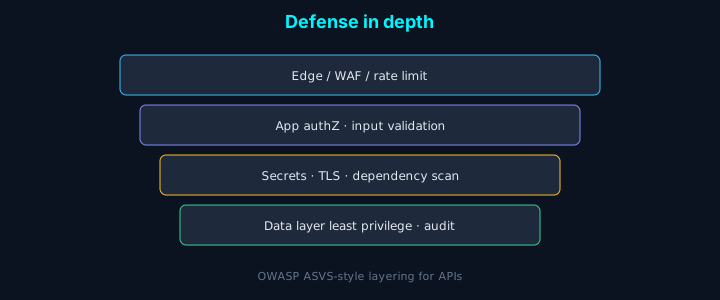
In one line: Security is not a single feature—it is defense in depth. Splitting responsibility across edge, app, secrets, and data layers shrinks blast radius when something goes wrong.
| Layer | Examples |
|---|---|
| Edge | WAF · rate limiting |
| App | Input validation · authorization |
| Data | Least privilege · audit logs |
Introduction
Web security deferred as “later” often becomes expensive after an incident. Using OWASP Top 10 as a baseline, here is what we check before ship—auth, authorization, input validation, and logging—with code sketches.
OWASP Top 10 overview
2021 OWASP Top 10:
- Broken Access Control
- Cryptographic Failures
- Injection
- Insecure Design
- Security Misconfiguration
- Vulnerable and Outdated Components
- Identification and Authentication Failures
- Software and Data Integrity Failures
- Security Logging and Monitoring Failures
- Server-Side Request Forgery (SSRF)
1. Authentication & authorization
Strong password policy
JWT handling
Rate limiting
2. Preventing SQL injection
Parameterized queries
Input validation
3. XSS (Cross-Site Scripting)
Output encoding
Content Security Policy (CSP)
4. CSRF (Cross-Site Request Forgery)
CSRF tokens
SameSite cookies
5. Data encryption
Encrypting sensitive fields
Enforce HTTPS
6. Dependency security
Vulnerability scanning
Automated updates
7. Logging & monitoring
Security event logging
Anomaly detection
8. Secure file uploads
Conclusion
Core principles for stronger web security:
- Validate input: validate and sanitize all user input
- Encode output: prevent XSS with proper encoding
- Harden authentication: strong passwords and MFA where appropriate
- Encrypt data: in transit and at rest
- Least privilege: grant only what is needed
- Security logging: monitor and record security-relevant events
- Dependency hygiene: scan and update regularly
Applying these practices materially improves your security posture.