
Brand positioning strategy: how to stand out in a crowded market
Key takeaway
In one line: Positioning is your relative place in the customer’s mind. Repeat one frame that combines a benefit line, proof, and contrast with alternatives.
Introduction: why positioning matters
As categories saturate, claiming a defensible “slot” becomes more important. Positioning is the strategy for how customers remember and choose you. Below is how we think about target, competition, differentiation, and messaging when shaping the itemSCV brand—written for people who ship, not only theorize.
1. Positioning fundamentals
A. What is positioning?
Definition
- Placing your brand in a distinct spot in the buyer’s mind versus alternatives.
- Clear answers to: Who are we? What do we do? Why pick us?
What it is not
- A feature laundry list.
- It is designing perception and memory.
B. Three pillars
1. Target audience
Who is this for?
2. Competitive frame
In which category or choice set do we compete?
3. Point of difference
What do we own that alternatives do not (or not as well)?
Checklist
- Target is specific enough to guide creative and product?
- Competitive frame matches how buyers actually decide?
- The difference matters to the buyer, not only to us?
2. Target customer analysis
A. Personas
Persona ingredients
- Demographics (age, role, income band—use what you can verify).
- Psychographics (values, lifestyle, interests).
- Behavior (how they buy, where they spend attention).
- Pains and desired outcomes.
Practical tips
- Interviews: 10–20 conversations to ground the persona in reality.
- Data: Purchase and analytics data to validate segments.
- Narrow when needed: Split overly broad “everyone” targets into actionable segments.
B. How buyers decide
Decision drivers
- Functional: Features, performance, price.
- Emotional: Brand feel and personal identification.
- Social: Status, belonging, peer proof.
Checklist
- What matters most when they choose in this category?
- Which brands do they pick today—and why?
- Where are they dissatisfied?
3. Competitive analysis
A. Competitive mapping
Competitor types
- Direct: Same product category, same budget line.
- Indirect: Different product, same underlying need.
- Potential: Could enter later (adjacent giants, new entrants).
What to capture
- Stated positioning and taglines.
- Target segments they emphasize.
- Strengths and weaknesses.
- Pricing and packaging signals.
- Visible marketing and channel mix.
Practical tips
- Digital recon: Sites, ads, social, and changelog rhythm.
- Reviews: Mine praise and complaints for differentiation hints.
- SWOT: One page per major competitor keeps the team aligned.
B. White space on the map
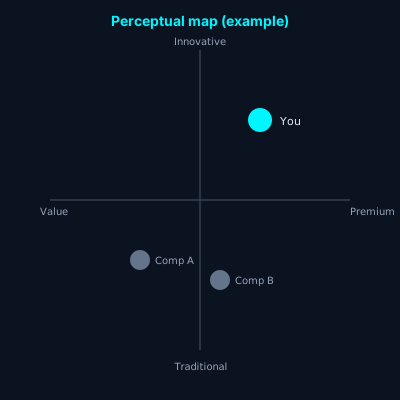
Positioning map
- Plot competitors on two dimensions buyers care about (e.g. price vs. quality, breadth vs. ease).
Practical tips
- Find gaps: Empty quadrants can signal differentiated territory—if demand exists.
- Avoid overcrowded quadrants unless you have a sharp wedge.
4. Deriving differentiation
A. Strategies
Levers
- Functional: Performance, reliability, integrations.
- Emotional: Story, identity, design.
- Experiential: Service, onboarding, community.
- Economic: Premium vs. value, pricing architecture.
Selection tests
- Meaningful to the customer?
- Defensible (not trivially copyable)?
- Communicable in a sentence or demo?
Checklist
- Is the wedge explicit?
- Does research support it?
- Can we sustain it operationally?
Practical tips
- Win interviews: Ask why customers chose you.
- Benchmark: Contrast against named alternatives on the same criteria.
- Capabilities map: Tie differentiation to what the org can actually deliver.
B. Unique value proposition (UVP)
UVP frame
- For whom is this?
- What outcome do we deliver?
- Why us versus the next best option?
Examples
- “10-minute healthy meals delivered for busy professionals.”
- “Design collaboration with real-time feedback and version control for creative teams.”
Practical tips
- One sentence: If it needs a paragraph, keep refining.
- Customer language: Outcomes over internal feature names.
- Test variants: Run messaging tests on landing pages or ads.
5. Messaging strategy
A. Message architecture
Layers
- Core message: The central promise.
- Supporting messages: Reasons to believe.
- Proof points: Metrics, logos, stories, certifications.
Principles
- Clarity over cleverness.
- Consistency across touchpoints.
- Differentiation from alternatives.
- Emotional resonance where appropriate.
Checklist
- Core message is memorable?
- It lands with the target segment?
- Channel variants still sound like one brand?
Practical tips
- Message house: One-pager linking core, support, and proof.
- Channel fit: Same truth, tuned tone for web vs. social vs. sales deck.
B. Storytelling
Story beats
- Hero: Often the customer, not the logo.
- Problem: The tension to resolve.
- Journey: Attempts, friction, insight.
- Resolution: How your offer helps.
- Outcome: Life after the change.
Practical tips
- Customer-first: Make their transformation the arc.
- Emotion with evidence: Pair feeling with concrete proof.
- Visuals: Video and imagery to reinforce the narrative.
6. Execution and monitoring
A. Rollout
Channels
- Site, social, paid, PR, content, events, sales enablement.
Checklist
- Touchpoints feel like one position?
- Internal teams (marketing, sales, support) use the same vocabulary?
- Product roadmap reflects the promise?
Practical tips
- Brand guidelines: Document positioning, voice, and examples.
- Training: Refresh internally each quarter or when strategy shifts.
B. Monitoring
Signals
- Awareness, associations, preference, and share where you can measure them.
Practical tips
- Pulse surveys: Quarterly or semi-annual brand tracking when budget allows.
- Social listening: Track unsolicited mentions and sentiment.
- Qualitative loops: Interviews and support themes for perception drift.
Conclusion: positioning is never “done”
Markets, buyers, and competitors move; positioning must evolve. Define clearly, execute consistently, measure perception, and adjust with intent—that loop is what makes positioning durable.