
Growth hacking strategy: growing fast on a lean budget
Key takeaway
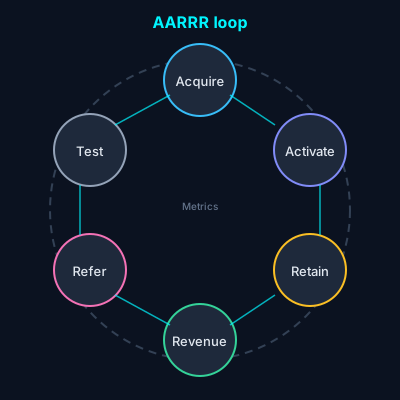
In one line: Growth is not one trick—it is a loop across acquisition, activation, retention, revenue, and referral. Link stage KPIs so experiment prioritization stays grounded.
| Stage | Guiding questions |
|---|---|
| Acquisition | Where do users come from; what is CAC? |
| Referral | Is there a real motive to share? |
Introduction: what growth hacking is
Growth hacking uses the product as a distribution engine to grow quickly without relying only on big paid budgets. This article captures how we think about viral loops, retention, and data-backed experiments for early- and growth-stage services.
1. Core principles
A. AARRR (“pirate metrics”)
The funnel
- Acquisition: How do users arrive?
- Activation: Do they experience core value quickly?
- Retention: Do they come back?
- Revenue: Do they pay (or hit monetization events)?
- Referral: Do they bring others?
Checklist
- One north-star metric per stage (or a small set)?
- Hypotheses and owners for improving each stage?
- Instrumentation and reporting in place?
Practical tips
- Focus: Do not optimize everything at once—attack the weakest stage.
- Dashboard: Data Studio, Notion, or your BI tool to view AARRR weekly.
B. Experiment-driven mindset
Loop
- Hypothesis: “If we change A, metric B will move because …”
- Design: Smallest test that could falsify the hypothesis.
- Measure: Pre-defined primary metric and guardrails.
- Decide: Ship, iterate, or kill.
- Scale or pivot: Double down or move on.
Checklist
- Weekly or monthly experiment backlog?
- Written results so the org learns from both wins and losses?
- Psychological safety to talk about failed tests?
2. Acquisition
A. Viral loops
Idea
The product experience naturally prompts users to invite others.
Examples
- Dropbox: Extra space for referrer and referee.
- PayPal: Bonuses for both sides on successful invites.
- Slack: Team invites spread usage inside organizations.
Practical tips
- Incentives: Reward both inviter and invitee when ethical and sustainable.
- Friction: One-tap share links, email invites, and clear copy.
- K-factor: Track average invites per active user; above 1 is rare and powerful—treat it as a diagnostic, not a vanity stat.
B. SEO and content
Playbook
- Publish useful content mapped to intent-heavy queries.
- Compound organic traffic over quarters, not days.
Examples
- HubSpot scaled huge inbound traffic with consistent marketing and sales education content.
- Brandi (South Korea) used fashion trend and styling content to earn search demand.
Practical tips
- Keyword research: Planner tools + Search Console + competitor gaps.
- Long tail: Specific comparisons and year-tagged queries often convert.
- Internal links: Tie related posts into topical clusters.
C. Partnerships
Angles
- Complementary products, communities, and distribution partners.
Practical tips
- Co-marketing: Joint webinars, bundles, and content swaps.
- Affiliates: Pay for qualified conversions, not noise.
- Communities: Sponsor or co-create with groups your ICP already trusts.
3. Activation
A. First-session value
Onboarding
- Shorten time-to-“aha” for the core workflow.
Checklist
- How many minutes to first successful use of the main feature?
- Is the path obvious without a manual?
- Is there an early “win” users can complete quickly?
Practical tips
- Guided steps: For complex products, progressive disclosure beats walls of text.
- Progress UI: Checklists and progress bars improve completion.
- Start with outcomes: Lead with the job they hired you to do.
B. Journey optimization
Approach
- Map touchpoints from first visit through first value moment; remove dead ends.
Practical tips
- Journey maps: Mark drop-off steps with analytics and session replay (where allowed).
- Micro-conversions: Email capture, sample data, or templates before asking for the big commitment.
4. Retention
A. Retention tactics
Why it matters
- Keeping existing users is usually cheaper than buying new ones—and compounds LTV.
Levers
- Rhythm: Useful updates, digests, and lifecycle messaging.
- Personalization: Relevant recommendations and segments.
- Community: Places to learn, share, and get help.
Checklist
- DAU / WAU / MAU or your equivalent tracked?
- Win-back or re-engagement paths before churn?
- Rewards or recognition for long-tenure users?
Practical tips
- Lifecycle email: Triggered sequences for dormant accounts—mind frequency caps.
- Push (mobile): High impact but easy to overuse; tie to real user value.
- Loyalty: Points, tiers, or perks that reinforce habit.
B. Product-led retention
Approach
- Ship improvements visibly tied to feedback.
Practical tips
- Feedback channels: In-app, NPS follow-ups, and support tagging.
- Fast follow-through: Close the loop when you ship what they asked for.
5. Revenue
A. Free-to-paid motion
Moves
- Show premium value: Let free users see what upgrades unlock.
- Fair limits: Usage caps that nudge upgrade without sabotaging evaluation.
- Timing: Prompt upgrades after value is proven, not on first click.
Checklist
- Do free users experience enough value to justify the upsell?
- Upgrade prompts appear at sensible moments?
- Pricing is legible and comparable?
Practical tips
- Trials of premium: Time-boxed access can lift conversion when the feature is sticky.
- Usage transparency: Dashboards of limits consumed create natural upgrade moments.
B. Pricing experiments
Approach
- Test price points, packaging, and presentation.
Practical tips
- A/B or geo tests: Compare conversion and revenue, not only click-through.
- Charm pricing: Test $9.99 vs. $10—but measure revenue and trust, not only CR.
6. Referral
A. Referral programs
Ingredients
- Incentives for referrer and referee where appropriate.
- Low-friction sharing: Links, prefilled messages, deep links.
- Attribution: Reliable tracking and payout rules.
Practical tips
- Personal links: Unique URLs per user.
- Status page: Let advocates see invites and rewards.
- Social proof: “Your network is already here” when true and privacy-safe.
B. User-generated content (UGC)
Ideas
- Make it rewarding and easy to post about outcomes your product enables.
Practical tips
- Hashtag campaigns: Clear rules and meaningful rewards.
- Customer stories: Turn strong quotes into ads, site proof, and sales assets.
Conclusion: growth is a habit, not a spike
Growth hacking is continuous experimentation—not a single viral hit. Use AARRR to structure work, measure honestly, and scale what works. Start small, compound wins, and learn from every test.